







Assessment of English Language Learners
Areas of Language Proficiency
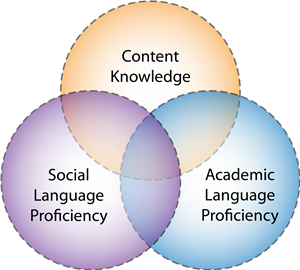
When assessing ELLs' literacy development, it's important to consideration the potential impact of each of the following aspects of language proficiency:
1. Social language proficiency: Communication in everyday language
These areas can be addressed within the context of assessing oral language, reading and writing in English.
Key Areas of Literacy Assessment
Oral Language
Understanding and speaking oral language provide a foundation for learning to read and write. Oral and written language have both receptive and expressive forms. Understanding words and sentences involves receptive language whereas speaking and writing words and sentences involve expressive language. In general, receptive language develops sooner than expressive in both oral and written modes.
In-depth language assessment is normally undertaken by speech and language specialists. Their assessments include standardized measures of 5 key aspects of language processing: phonology, semantics, syntax, morphology and pragmatics. However, unless some serious underlying language disorder is involved, informal assessment approaches by ESL teachers are more appropriate to determine how well an ELL student is functioning at school and what accommodations or supports they may require in order to handle the oral and written language challenges of English.
Depending upon an ELL's particular background and experience with spoken and written language(s), the ESL teacher, in collaboration with the classroom teacher, will need to explore potential deficiencies in the student's Social Language Proficiency, Content Knowledge and Academic Language Proficiency in English. Deficiencies in the latter two areas often underly ELLs' difficulties in English language school learning tasks.
Informal contexts in which to assess listening and speaking in English:
- One-on-one conversations with students
- Sequencing/sorting/matching pictures
- Activities or games that require rule following
- Student-led conferences on topics of interest
- Role-plays, oral presentations, and think-alouds
- Audio or video recordings of student progress (e.g., oral presentations)
- Observing dialogues between students
Reading
Reading is a complex process and a thorough assessment needs to include measures of 5 key components:
- phonological & phonemic awareness
- letter-sound knowledge & phonics
- vocabulary
- reading fluency
- reading comprehension strategies
These 5 foundational components are central to all students' success in learning to read English, including ELLs who are learning to read in English for the first time, irrespective of their age. Each of the components is described in the "Food Groups" section of this website and many classroom literacy "recipes" (lesson plans) and videos explain and demonstrate how to teach and assess these essential components in the classroom. For older ELL students who are just beginning to learn reading in English, irrespective of their age-based grade placement, they will need age-appropriate instructional support to become skilled readers.
Reading assessments for ELLs can begin informally -- depending on the language background, age and grade of the students -- with observation during literacy activities in the classroom to determine whether there is a need for a more in-depth approach. A range of simple measures to assess early reading skills are available at Reading Rockets.
Young ELLs' foundational reading skills can be assessed using games and activities such as those available at Starfall. Examples of some informal activities for beginning readers:
- Letter identification activities on Starfall
- Letter-sound association activities on Starfall
- Games on Starfall that involve decoding short words by combining different initial letter-sounds with the same ending to produce rhyming words
- Reading little decodable books involving the short vowel sounds on Starfall
- Games with Sight Word flash cards
- Running Records of student read-alouds
- Reading aloud simple books involving high frequency words
- Use drawings or pictures to assess comprehension of texts
Writing
As adult skilled writers, it is easy to forget how complex writing is. It involves thinking about and doing many different things at once, like forming letters, spelling, selecting words, and formulating ideas. Learning to write involves juggling a few basic writing skills at first, and then slowly adding others. Eventually, with practice, writers are able to do all of this simultaneously. The challenges for ELLs are even greater! In particular, their expressive oral vocabulary and content knowledge limit what words they use in their written work. Also, their expressive oral language fluency determines how well they are able to express ideas and explain concepts in writing.
In order to determine an ELL's areas of strength and weakness in writing, assessment needs break the process down into subcomponents and determine the student's facility with each of the components of writing. In addition, observing the writing process in action and examining the final product are very helpful indicators of how well the student is able to put all the pieces together.
A few components to consider as part of informal assessment of writing include:
- mechanics -- letter formation, keyboarding, punctuation
- spelling (both spelling accuracy of high frequency words and inventive spelling of less common words)
- breadth of vocabulary and precision of word choice
- sentence structure and grammar
- generation of ideas
- organization, paragraphing
The age and experience of the writer will determine which of these aspects of writing is appropriate to consider in the assessment.
Some possible contexts in which to perform informal assessment of writing:
- Written response to a prompt -- topic of interest, picture, video clip, etc.
- Label pictures, figures or diagrams
- Describe places or people
- Write texts and e-mails
- Create brochures, compose journal entries, write book reports
- Summarize oral presentations or movies
- Create portfolio of dated written work throughout the year
Summary
The best measure for language proficiency is performance in class, not standardized tests. Ongoing assessments are especially important for ELLs. Use classroom learning tasks as opportunities for assessment and provide specific feedback to students. Engage ELLs in assessment by making it fun! Conduct your own initial assessments and, when possible, also conduct the initial assessment in the student's first language to better understand their language development and content knowledge.
Modifying Assessments for ELLs
- Give extra time for students to process and respond
- Use alternative forms of assessment such as oral interviews, learning logs, or portfolios
- Use simplified language and instructions
- Assess content knowledge and language proficiency separately
- Avoid multiple-choice and true/false assessments as they often depend on comprehension of subtle differences
- Observe and record student progress
- Include observations as part of other assessments
- Involve students in assessment by having them set their own goals and evaluate their progress
- Ensure that you are not asking ELLs to respond to content they have not yet learned or about cultural situations with which they may be unfamiliar
- Reduce homework demands or allow for additional time, as work may take longer to complete
Distinguishing ELLs from LDs
Dr. Esther Geva discusses the importance of assessing ELLs' progress over time in learning to read and write
ELLs' Prior Experience with Literacy
Special Note: Informal assessment should include an exploration of the students' prior experience with language and literacy. Depending on their home language and any previous schooling, some ELLs may be better equipped than others to learn to read and write in English.
Differences between the home language and English in the phonology and grammatical structures can present a challenge for ELLs learning to read and write. If they are unfamiliar with some English speech sounds ELLs may have difficulty hearing those sounds and articulating them in words. Such phonological differences may affect their decoding in reading and their spelling in writing. In addition, a difference in grammatical structures across languages could make predicting meaning from context and thus impact fluency and comprehension in reading text in English.
Other challenges to learning reading and writing in English may result from across-language differences in writing systems. For example, ELLs coming from other counties may or may not have had reading and writing instruction in their home language. In addition, prior home language experiences may facilitate or interfere with ELLs' learning to read and write in English. Some languages, such as French, Italian and Spanish, involve the same alphabet as English, and many words are closely related in sound and meaning to English words. ELLs who come from such backgrounds may be expected to transfer their prior reading and writing experience to learning in English. Other ELLs may have had prior experience reading in another writing system, such as Chinese, that involves symbols for whole words and lacks a symbol-to-sound correspondence. Still other ELLs may come from countries where there is no written form for the oral language, so reading may be a "foreign concept" for them. Thus, ESL teachers and classroom teachers need to keep in mind the possibility that variations in prior written language experience may be playing a role in an ELL students' ease or difficulty in learning to read in English.
Practitioners' Insights: Make It Engaging !
Watch an Experienced ESL/ELL Teacher talk about how interactive assessment is motivating for students and informative for teachers:
More Than a Test: Using Interactive and Fun Assessments to Understand Student Thinking
A Speech and Language Specialist describes an approach she uses to elicit language from ELL students who are often reticent to speak:
Tell Me More, Tell Me More!: Using Prompts to Get Beyond One-Word Answers
An Experienced Kindergarten Teacher with many ELL children in her classroom uses motivational approaches to assess what they understand and can express in English
Story Re-enactment: Assessing Comprehension with an Oral Retell
Featured Videos
Expert Insights
Dr. Jim Cummins points to parallels between ELLs' progress in first and second language literacy.
Second Language Literacy Progress: Assessment in Consultation with Parents
Second Language Literacy Expert explains the importance of exploring first language literacy to understand challenges ELLs face in developing second language literacy
First Language Behavioral Markers: Dr. Esther Geva Provides Guiding Questions for Teachers
Speech and Language Specialist explains the essential link between a child's oral and written language abilities
Understanding and Speaking Come First: Using Oral Language to Develop Written Expression
Classroom Contexts for Informal Assessment
Silly Sound Attendance: Building Phonemic Awareness
The Drama Center: Building Oral Language and More
Useful Additional Resources:
Practical Contexts for Informal Assessment in the Classroom


 The Name Game: Building Awareness of Sounds and Letters
K
Before, During and After Questions: Promoting Reading Comprehension and Critical Thinking
2nd - 3rd
Running Records: Assessing and Improving Students' Reading Fluency and Comprehension
K - 3rd
Concentrating on Sight Words: Promoting Reading and Writing Fluency
K - 3rd
Let's Vest Up: Reviewing Letter Sounds Through Song
K - 1st
