







Expanding Proficiency
Instructional Focus for ELLs
In order to support the literacy development of students at the Expanding Proficiency level, it is important to offer an appropriate balance of language and literacy activities in the teaching program. At this point, because students have developed more fluency in oral language and a foundation in print-related skills, greater instructional emphasis should be placed on raising the level of their oral language communication, comprehension strategies in reading, and composition strategies in writing.
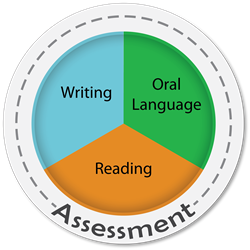
The appropriate program balance for students will vary but, in general, the focus in the classroom should be on teaching and modeling higher-level language and literacy strategies. Key to the success of ELLs will be to build their Content Knowledge and Academic Language Proficiency through engaging instruction and meaningful practice. ELLs' understanding and use of content-specific vocabulary and academic language will determine their ability to learn new information in various subject areas, to comprehend and retain text information, and to formulate and express ideas orally and in writing. Explicit instruction and modeling are important teaching tools, followed by a gradual release of responsibility to the students as they gain confidence. The "Healthy Plate" above suggests a rough balance of oral language, reading and writing activities for students at the Expanding Proficiency level. As their receptive and expressive vocabulary and oral language levels grow, ELLs are better equipped to understand and remember complex concepts in their reading and to express increasingly complex ideas in their writing. Ongoing informal assessment should be used to determine the balance of oral language, reading and writing activities required for each student and for the class as a whole.
Oral and Written Language
Foundations of Literacy
The purpose of reading is to get meaning from printed text and the purpose of writing is to convey meaning with text. There are two main components that are both essential to reading comprehension and written composition: Oral Language abilities and Printed-Related Skills.
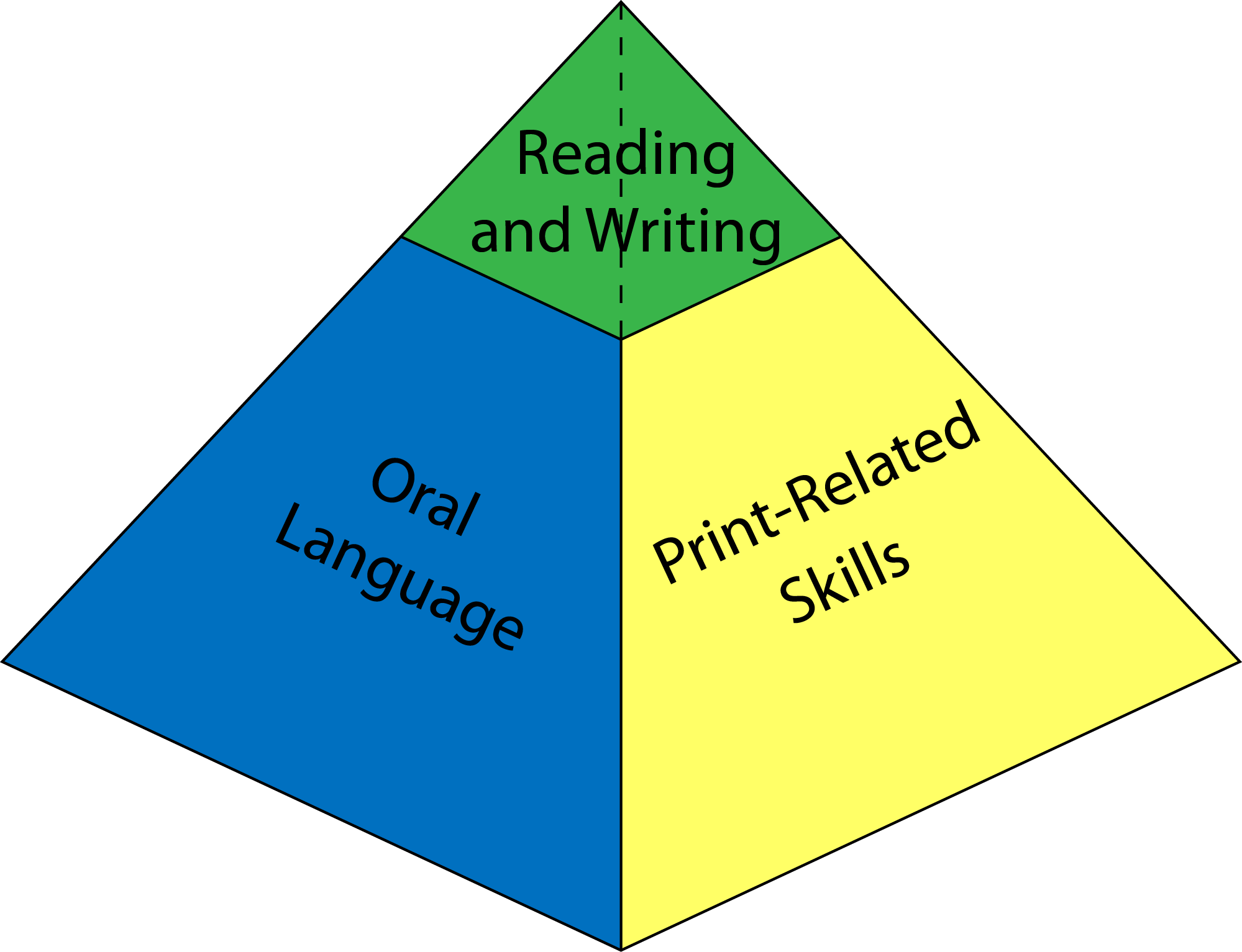
Oral Language Abilities:
For Expanding Proficiency ELLs, their Oral Language abilities in English – their understanding of the language they hear and their ability to express themselves in spoken language – are well developed in social situations. However, their mastery of the language of school still lags behind. Thus the emphasis in the oral language component of their literacy program needs to shift toward building Content Vocabulary and Academic Language Proficiency through both direct and indirect instruction in the following literacy diet "food groups":
- Oral Language
- Vocabulary
- Knowledge Building
Print-Related Skills
In addition to further developing their oral language facility, Expanding Fluency ELLs need to increase their use of higher-level comprehension strategies in their reading, to become more confident users of appropriate mechanics, spelling and text structures in their writing, and to increase the richness and complexity of their written language expression. Thus the following literacy diet food groups require instructional emphasis at this point:
- Spelling & Word Study
- Writing Conventions
- Text Structures & Genres
- Reading Comprehension Strategies
- Writing Processes & Strategies
*IMPORTANT NOTE: Not all students begin at the same place – their level of language and literacy in their L1 will play a role in how they progress in their L2. Students can be at the Expanding Proficiency level in various grades. Thus, for older Expanding Proficiency students, the activities presented in this section will need to be modified to suit the age and maturity of the students, but the basic principles underlying them apply: the activities need to involve a range of supports and promote active engagement.
Useful Additional Resources:
In the Classroom: Learn about using classroom texts, find out what whole-child literacy instruction looks like, and dive deeper into comprehension, content area literacy, writing, and social-emotional learning.
English Language Learners: This resource outlines effective approaches to teaching ELL students in schools, ways to create a welcoming classroom environment and strategies to promote family involvement in students' literacy development.
Expanding Proficiency in the Classroom
Tour a Classroom
Meet the Teacher
Oral Language
Teaching tips:
- Explain and demonstrate or model new assignments to ensure that students understand expectations
- Co-develop and post "success criteria" in various subject areas so that students will learn to self-monitor
- Teach and practice all new academic vocabulary
- Encourage students to use the proper vocabulary terms in various subject areas
- Extend knowledge and vocabulary by reading aloud from fiction and/or nonfiction daily
- Continue to build knowledge through shared experiences, videos and the internet
- Extend vocabulary development both directly and indirectly throughout the day
- Provide many opportunities for students to express their ideas orally in class
- Teach students how to generate questions that will move their dialogue forward
- Teach, model and have students practice appropriately adjusting their speaking for various purposes and audiences
- Model and encourage students to elaborate on their opinions, by using reasons and details to participate in meaningful dialogue that contributes to academic learning
Reading
Teaching tips:
- Create a print-rich environment co-developed with students, displaying their work
- Use an interactive white board or document projector, computers, and the internet to engage students in meaningful literacy activities
- Provide authentic opportunities through the day for extensive independent reading across genres and subject areas
- Teach students the features of various text structures and demonstrate how they can be used to describe, inform, explain, persuade, etc.
- Teach students to synthesize and critically analyze new information from a range of print sources
- Foster a love of reading!
Writing
Teaching tips:
- Motivate interest in writing through the use of technology such as interactive white boards, tablets and computers
- Create a grade-appropriate word wall to consolidate and extend students' understanding and spelling of high frequency words
- Co-develop with students a word wall that includes interesting words they hear or read and may want to use in their future writing -- focus on their use, origins and meanings
- Create separate word walls for content area vocabulary ' for example, use a "math word wall", a "science word wall", to feature important words students need to understand and use in their respective content areas
- Model the use of the word walls to support spelling, word study and writing
- Increase focus on proper word usage and grammar
- Encourage use of new vocabulary in writing
- Introduce various text structures and genres in reading and follow up with writing activities
- Develop students' analytical and critical thinking skills through written responses and reflections
- Encourage students to use appropriate vocabulary from learned content in written work
- Provide group assignments in which students, in pairs or teams, will begin to develop research skills
- Introduce writing genres such as comics, tall tales, and fairy tales, as well as essay writing supported by independent research
Classroom Wisdom from an ESL Teacher
An experienced ESL/ELL teacher discusses the importance of exploring students' language proficiency in various areas of the curriculum in collaboration with classroom teachers to better understand and support ELL students' needs.
Mathematics to Physical Education: Supporting ESL Students Across the Curriculum
Featured Videos
Expert Insights
Dr. Esther Geva explains potential impacts of the various backgrounds that ELL students may bring to the school learning situation.
The Challenges of Academic Language: Lack of Content Knowledge and Limited Prior Schooling
Classroom Strategies
Instructional Terms: Helping Students Expand Vocabulary
Read Alouds Across All Elementary Grades: Motivating Literacy in the Classroom
Make it Personal: Connecting Students to Texts
Double the Fun: Exploring Homonyms
Are you Convincing?: Writing Persuasive Reports
Schema Folder: Investigating a Topic to Foster Knowledge Building
More Expanding Proficiency Literacy Recipes and Videos


 The Wall of Science: Anchoring Students' Learning (Virtual Tour)
3rd - 6th
The KWL Chart: Building Knowledge with a Graphic Organizer (Virtual Tour)
2nd - 6th
The Game of Jeopardy: Reviewing Information (Virtual Tour)
4th - 6th
Celebrating One Hundred Books: Promoting the Enjoyment of Reading in Fourth Grade (Virtual Tour)
2nd - 4th
Act it Out!: True Story of the Three Little Pigs Builds Understanding of Point of View (Virtual Tour)
4th - 6th
